By Georgie Dennis
Colonial Policy, religious affiliation, and Africa
To what extent is the Anglican Church responsible for the implementation of Anti-Sodomy Legislation in Uganda and its continuation today?
One pillar of research in post-colonial academic discourse is the continually influential legacy of colonial policies that were imposed upon now-independent nations from imperial metropoles. Some of these policies, such as the anti-homosexuality laws in varying African countries post-colonisation, have continued to be upheld. Acts against homosexuality, especially in a colonial context, are typically interpreted to be the result of the influence of the Church. In the case of Uganda, this notion seems to be supported and perpetuated by various religious actors. Theologist Rowan Strong argues that within the British Empire, “Anglicanism suffused imperialism and influenced policy”.1 Baptist John Clifford similarly denoted how Anglican missionaries went to Uganda to “carry men to redemption and renewal”,2 and stipulated that Anglicanism had a key role in shaping the domestic field in the protectorate. This emphasis on this religious cause for such a policy does not recognise, however, that the timing of this legislation was well after Anglican missionaries first arrived to Uganda, and was instead much closer to when Uganda was granted independence. Thus when considering the timing of this law, it is more logical that drive behind it was actually an aim for Britain to have influence over Uganda that would maintain a hold even in Uganda’s post-colonial age.
This essay will argue that the Anglican Church was not completely responsible for the implementation of the anti-sodomy legislation, but that morality and religious ideology was used to excuse its implementation. The law was, at root, a means to enhance Britain’s control of the colony. This essay will also demonstrate how the content of this law enabled Britain to gain control over Uganda, and how this control still lingers today.
The Penal Code Act published on June 15th 1950, with sections 145, 146, and 148, is the first piece of legislation in Uganda to criminalise sodomy. The primary and perhaps most obvious reason for thinking that the Anglican Church was responsible for the implementation of this legislation, is that anti-homosexuality has been widely interpreted as a value of the Anglican Church. The Anglicans, according to Strong, governed the colonised peoples of Uganda the way they claimed God would have wanted, implying they would have enforced their values on the colonised peoples.3 Missionary Advocate JFT Hallowes reiterated the importance of Anglicanism in the British imperial project, describing Anglo-Saxons as the chosen people who endorsed “the purest form of Christianity current in the world”, thus being those most fit to colonise.4
The Anglican Church did quickly integrate into Uganda’s political system. In 1877, the Anglican Church implemented the Church of Uganda, which according to Holger Hansen, was the “overriding objective of the Uganda mission”: the establishment of an independent African Church that would emulate the Church Missionary Society (CMS) and replace it in later years.5 The Church of Uganda, along with the Buganda Agreement of 1900, cemented the state of affairs in Uganda. It confirmed the Protestant hegemony, “providing it with a certain outward legitimacy”,6 and dictated that rulers throughout the Ugandan protectorate privileged Christian (and particularly Anglican)7 chiefs. Seats were appointed in the Lukiko8 based on religious groups, and after this agreement the Lukiko was made up of 49 Anglicans, 35 Catholics, and 5 Muslims.9 The early integration of Anglicanism into Ugandan politics and the law’s content aligning with its their values heavily suggests that the implementation of this legislation was due to the influence of Anglicanism. Though if this were the case, it would be more sensical for it to quickly follow the Buganda Agreement. Instead, it takes 50 more years.
The timing of this law is therefore fundamental context in determining the true reasoning behind its implementation. The penal code was introduced in 1950. In 1945, there had been many strikes and riots throughout Uganda. Sir John Hathorn Hall, the governor of Uganda, saw that this movement was the result of “careful and wide spread organisation which had primarily a political purpose aimed at paralysing government and other essential services”.10 The East African Standard issue from January 26th, 1945, corroborates this:
[…] there was a political objective inspiring the strikers, apart from the financial hardships against which most of the strikers had been agitating.11
The Bataka Party makes the national discontent more pointed in the manifesto they sent to the British prime minister, Uganda’s governor and Kabaka, and the United Nations on August 8th, 1948:
We do not want the British to keep on telling us we are not able to govern ourselves while they continue to misrule us, rolling in stacks of our money and deliberately hindering and retarding the normal development of the political, economic and social life of our country […] We do not want Britain to organize anything for us any more in Uganda; we will do so ourselves.12
This party was also believed to be involved in disturbances that took place in 1949.13
These subsequent disturbances made the British even more concerned about their extent of political control. In a House of Commons debate from the May 25th, there was clear arising suspicion and infighting, highlighted by a member of Parliament questioning if the Under-Secretary was withholding information regarding the riots:
… why is it that he has not any further information of what happened on this particular occasion when these killings and arrests took place; and if he has the information why does he not give it to the House?14
The British government was also planning on decolonising their empire in the Far East of Africa around this time. The methods of this new era for Britain’s empire and the ideas behind them were addressed in a House of Commons debate from July 20th, 1949.15 Mr Jones, Secretary of State for the Colonies, called attention to how their colonial territories were “going through a state of transition in regard to political, economic and social changes”.16 What with the post-war withdrawal from India the year before, and the increase of a more liberal philosophy regarding the Empire – “What is the broad purpose we have in mind in regard to colonial policy? None of us in these days seek the mere satisfaction of colouring red great areas on the map”17 – this statement seems true, though this does not mean the British were planning on loosening their political hold on their colonies in East Africa, but the opposite:
[…] we should [reduce] so far as is possible the internal strains and [secure] not only the internal co-operation of the peoples in the territory itself, but also their full co-operation with us in the work which we too are trying to do.18
This aim for eventual self-governance falls in line with the proposed reasoning behind the Anti-Sodomy Legislation: a means for Britain to dictate how the countries in Africa would develop. Sir Donner said in this debate that they had to decide the “kind of civilisation [they] desire to build up in each area”, and he suggested they determine one set of values to teach widely.19 This was deemed impossible on the grounds that they would not be able to fund that scale of education, but one could speculate that this Penal Code was, in part, a cheaper alternative to teach the ‘values’ that the British wanted propagated in these colonies.20
Foucault would argue that this Act, in generating “productive power”, guarantees British influence over Uganda that transcends the contours of colonialism.21 Policing an act conceptualises it and establishes this understanding of it as the undeniable truth. When this understanding is instutionalised, the act transitions from something one does, to tangible discourse in its own right. Ugandan Academic Sylvia Tamale denotes how through labelling certain acts as “against the order of nature”,22 the fluidity of sexuality and gender expression is forced into westernised labels, and diminishes Ugandan culture while uplifting British norms.23 Through westernising what was once an integral part of Ugandan culture, the values of the missionaries and intrinsically, the values of the Anglican Church, were all that was left to fill in the gaps of what used to be Ugandan culture. This suggests that it was not the influence of the Anglican Church that led to this law, but instead this law that validated the views of Anglicanism, and thus drew more of the Ugandan population towards it.
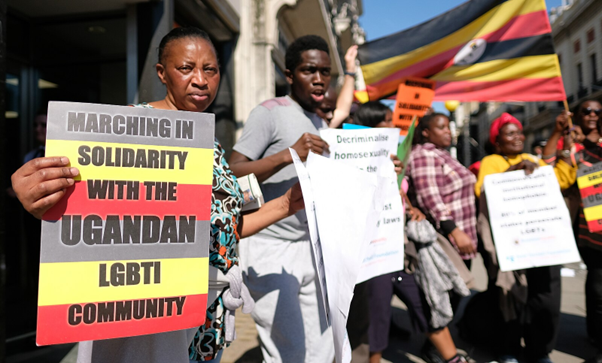
The legacy of this code continues today, with its latest amalgamation being the anti-Homosexuality bill of 2023. The colonial legacy of Britain within Uganda manifests through the anocracy that has emerged in the years following its independence. Through the colonial administration passing power along, not to the people of Uganda, but to a new king and to new sovereigns that would inherit the colonial tools of governance, the power structure of colonialism was internalised, so the laws and values established in that era have been maintained.
Bibliography
- Rowan Strong, Anglicanism and British Empire c.1700-1850, (Oxford: OUP Oxford, 2007), p. 120.
- William Carey, Missionary Sermons: A selection from the discourses delivered on behalf of the Baptist Missionary Society, (London: Carey Press, 1924), p. 154.
- Strong, Anglicanism and British Empire c.1700-1850, p. 285.
- James G Greenlee, Charles M Johnston, Good Citizens: British Missionaries and Imperial States, 1870-1918 (Montreal: McGill-Queen’s University Press, 1999) pp.42-3.
- Holger Bernt Hansen, “Church and State in Early Colonial Uganda.” African Affairs 85, no. 338 (1986) p. 58.
- Holger Hansen, Mission, Church and State in a Colonial Setting: Uganda 1890-1925, (London: Palgrave Macmillan, 1985) p. 419.
- Jason Bruner, Living Salvation in the East African Revival in Uganda. (Suffolk, UK: Boydell & Brewer, 2017), p. 50.
- The parliament of the Kingdom of Buganda.
- Bruner, Living Salvation in the East African Revival in Uganda, p. 50.
- See: Cohen, British Policy in Changing Africa, p.35; Thompson, “Colonialism in Crisis: The Uganda Disturbances of 1945,” African Affairs 91 (1992), p.608; Twaddle, “The Struggle for Political Sovereignty in Eastern Africa, 1945 to Independence,” pp.228-232; Apter, The Political Kingdom in Uganda, pp.226-233; Ramkrishna Mukherjee, Uganda: An Historical Accident? Class, Nation, State Formation (Trenton: Africa World Press, 1985), p.35; Despatch from Sir John Hathorn Hall to Oliver Stanley, January 28, 1945, NA CO 536/215/40339/1/1945.
- Thompson, “Colonialism in Crisis: The Uganda Disturbances of 1945.”, p. 610.
- See: Summers, Carol. “Radical Rudeness: Ugandan Social Critiques in the 1940s.” Journal of Social History 39, no. 3 (2006) p. 756.
- PD, Commons vol. 467, cc.1365-6 (20 July 1949), debate on Uganda (Situation).
- Ibid.
- PD, Commons vol. 467, cc.1392-505 (20 July 1949), debate on Colonial Affairs.
- Ibid.
- Mr Jones, in the same speech.
- Ibid.
- Ibid.
- Ibid.
- Michel Foucault, History of Sexuality, (New York: Pantheon Books, 1978), p. 94.
- Uganda: The Penal Code Act (Cap. 120), 1950 [Uganda], 15 June 1950.
- Sylvia Tamale, African Sexualities: A Reader, (Pambazuka Press, 2011) p. 11.